
LUMO Ghost Check
Paste a job link and get a ghost-risk score, a plain verdict, the warning signs and one next step. The work was making the score deserve trust: what counts as evidence, whether each check ran, and whether the words agree with the number.
- People act on the ghost score, and the first version could not be trusted. A real job posted on three boards could collect 60 to 90 points. The search behind five signals timed out on 35 of the last 40 checks. One live report showed a score of 31 beside a summary that said “high chance of being a ghost job”.
- I rebuilt the scoring so cross-posting and missing data are not evidence, cut the slow calls so every signal runs, put the band cutoffs in one module, and added a filter that rejects a summary that contradicts its band. The public checker asks for no login and no email.
- All 15 signals ran on live checks after the fix, and the report shows the status of each one. A packet build stops at a score of 70; from 61 to 69 the person decides. Usage numbers stay private.
On this page
A ghost job is a posting that nobody is hiring for: the role is filled, frozen, or left up. A person in a layoff who tailors a resume and writes a letter for one loses hours they do not have.
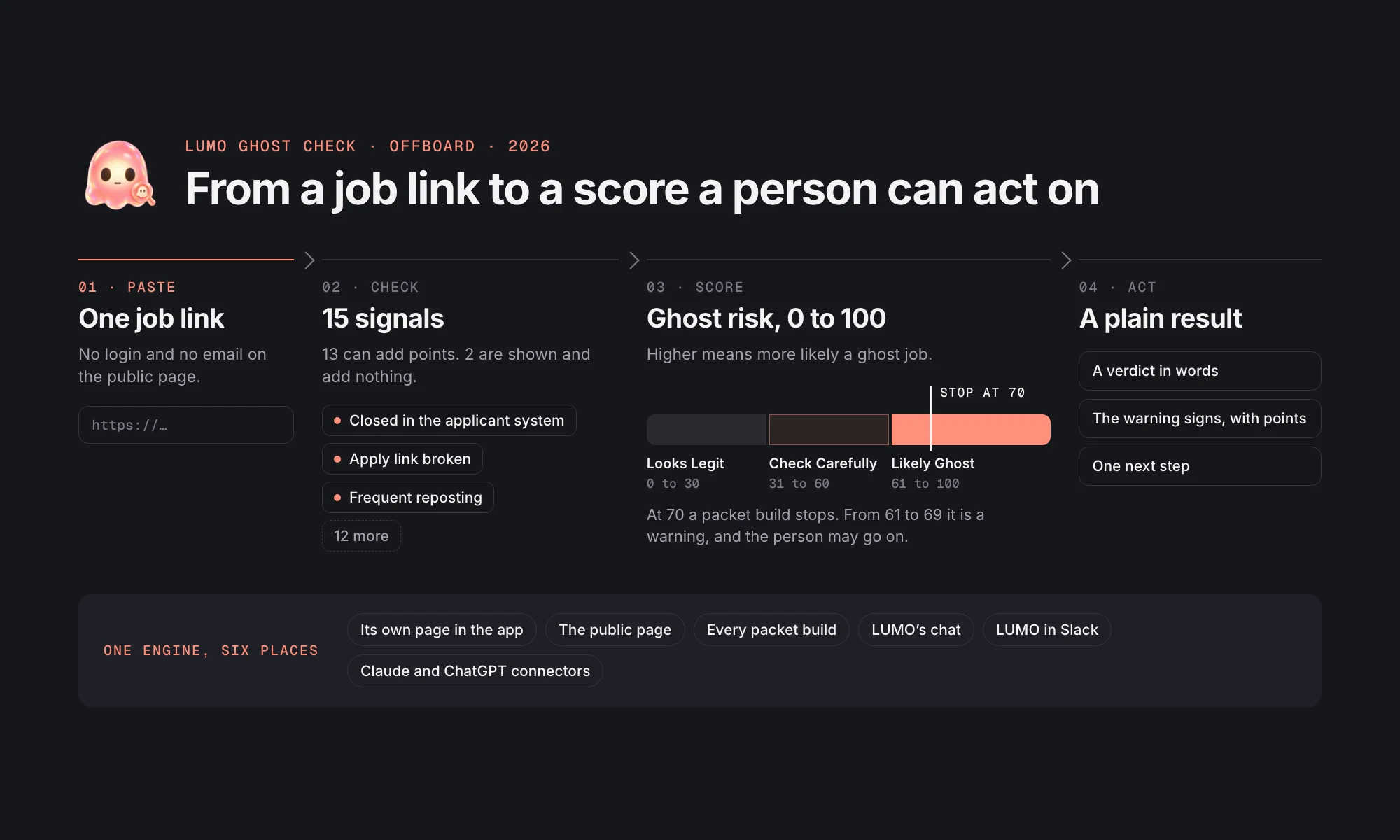
The ghost check takes a job link and returns a ghost-risk score from 0 to 100, a plain verdict, the warning signs it found with their points, and one next step. A higher score means the posting is more likely a ghost job. The check first shipped inside Offboard in January 2026. A public version with no login went live on August 14, 2026.
One engine runs every check, so a fix lands in each place at once. It runs in six places: its own page in the app, the public page, every packet build, LUMO's chat, LUMO in Slack, and the Claude and ChatGPT connectors.
The score is the sum of 15 signals. Thirteen can add points, each up to a set maximum. Two, a missing posting date and thin job details, are shown for information and add nothing.
People act on this number. They skip a job, or they spend an evening on it. So the design problem is trust. The score must not punish a normal posting, must not hide a check that did not run, and must not be contradicted by its own summary. I made those calls and built the checker with AI coding agents in the loop.
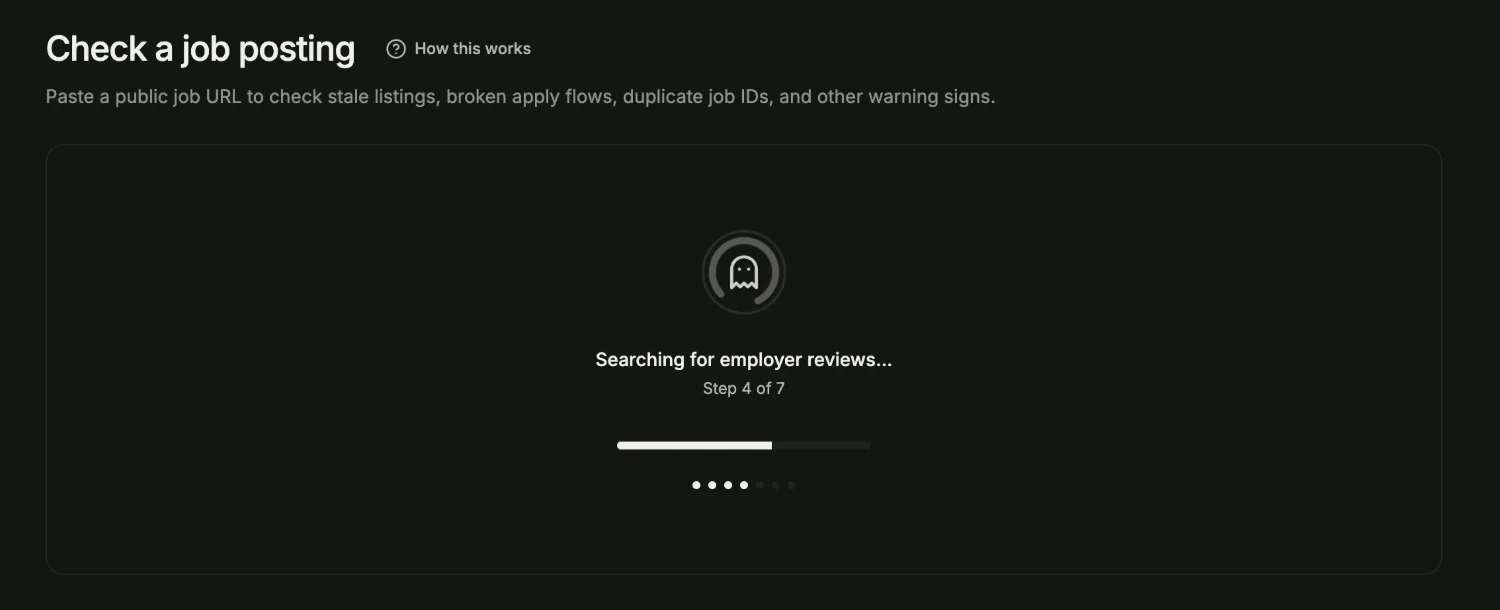
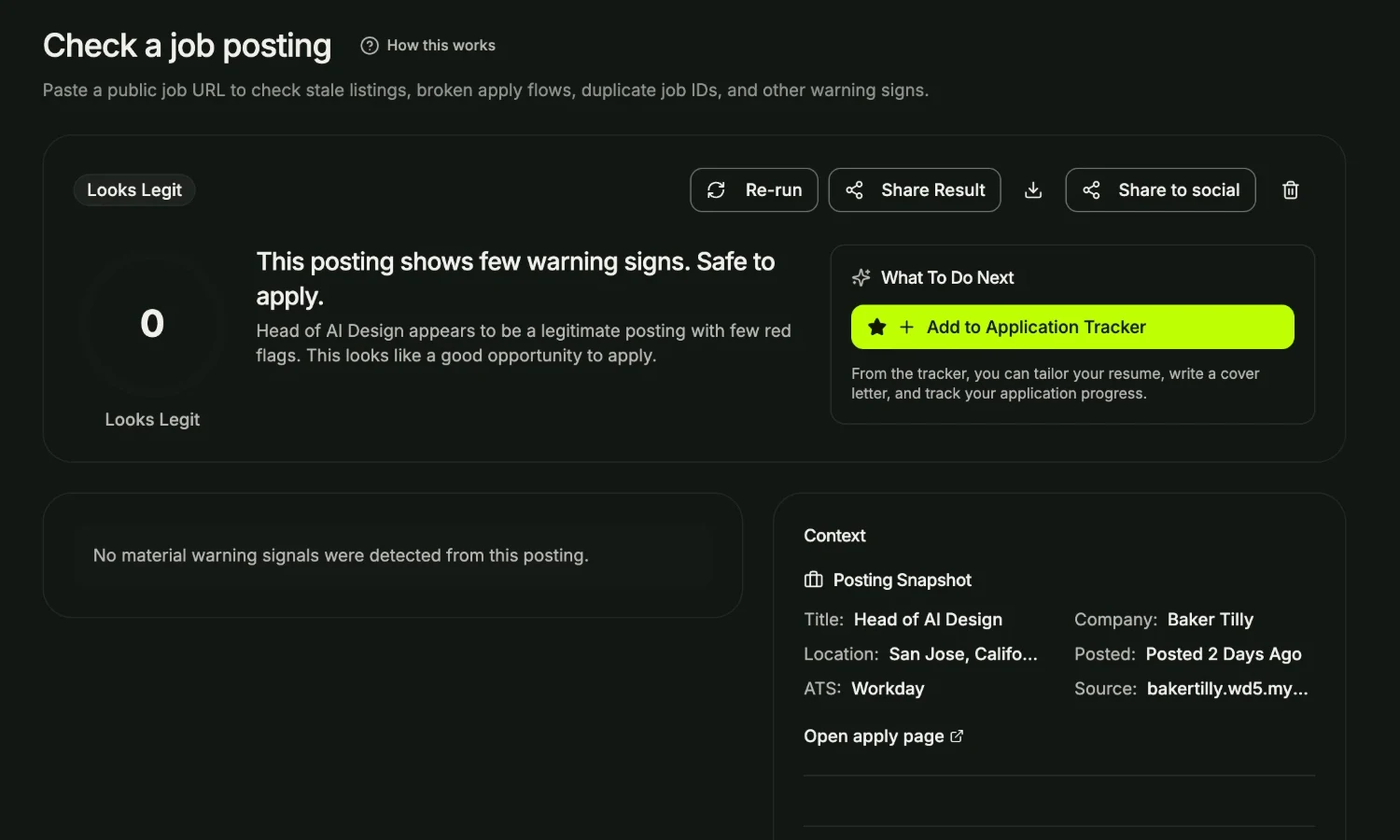
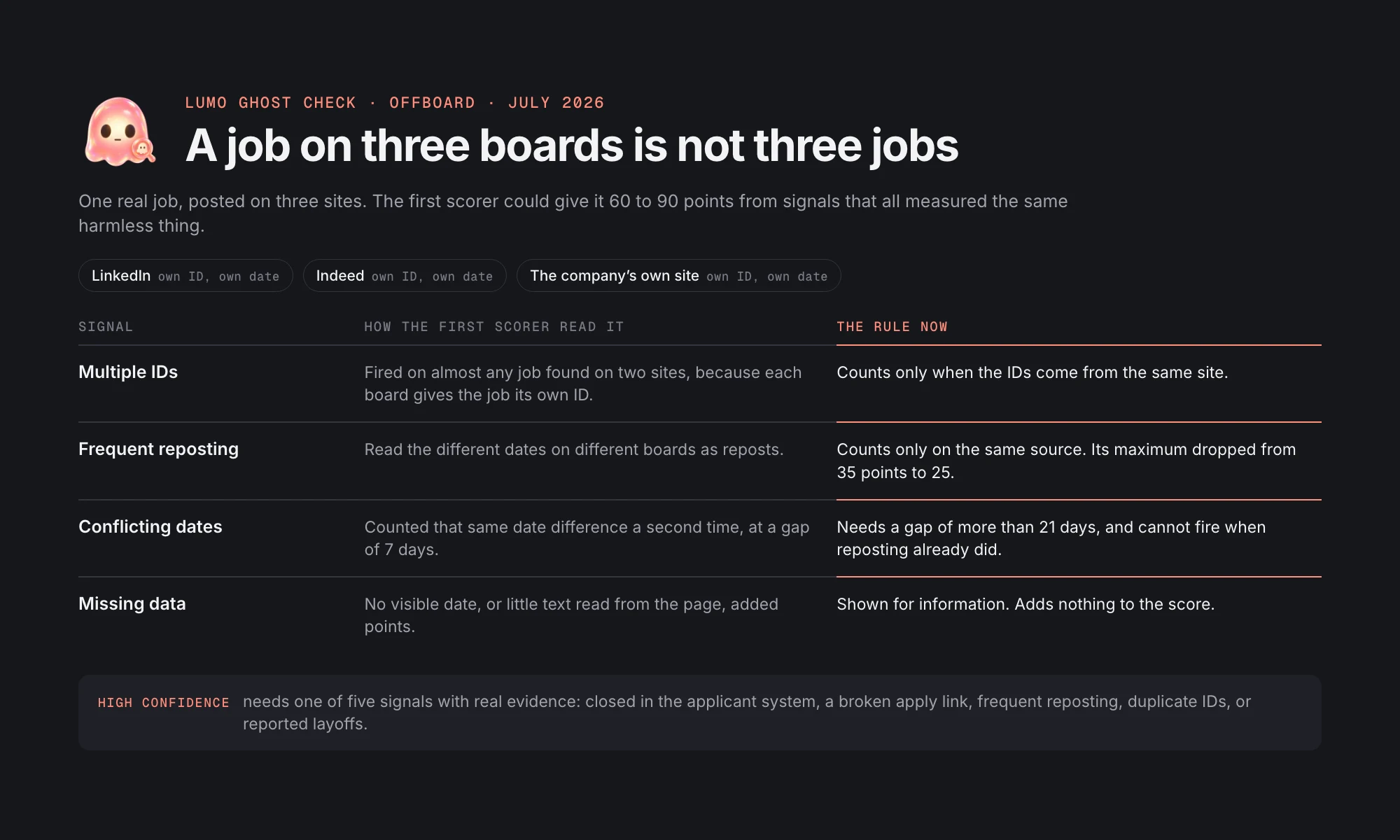
The first scorer counted normal cross-posting as ghost evidence. A real job posted on LinkedIn, Indeed and the company's own site could collect 60 to 90 points from signals that all measured the same harmless thing.
- Each board gives the job its own ID. So "multiple IDs" fired on almost any job found on two sites.
- Each board shows its own date. "Frequent reposting" read those dates as reposts, and "conflicting dates" then counted the same difference a second time.
- Missing data scored as evidence. A posting with no visible date, or one our own reader got little text from, gained points. A legitimate posting could reach the top band with no real ghost signal.
The fix, in July 2026:
- Same source only. Duplicate IDs count only when they come from the same site. Reposting counts only on the same source, and its maximum dropped from 35 points to 25.
- No double count. A date conflict needs a gap of more than 21 days, where it was 7, and cannot fire when reposting already did.
- Missing data adds nothing. It is shown, and it does not move the score.
- High confidence needs evidence. A result is labeled high confidence only when at least one of five evidence-bearing signals fired: closed in the applicant system, a broken apply link, frequent reposting, duplicate IDs, or reported layoffs.
Before the change, the scoring code sat inside one 2,247-line function with no tests. I moved it into a pure module and wrote tests that pin its behavior first.
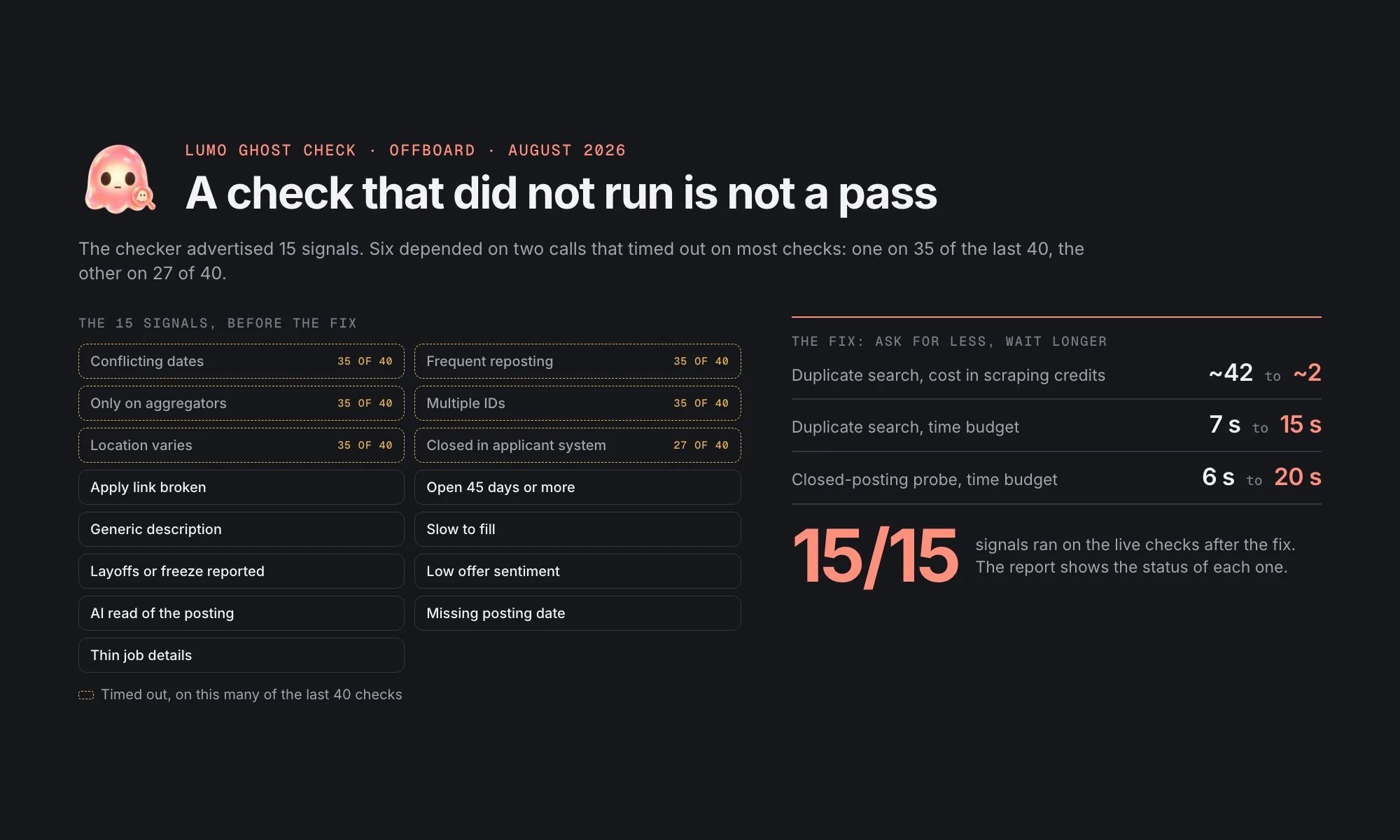
In August 2026 the checker advertised 15 signals, and several of them almost never ran in production. The search for duplicate postings timed out on 35 of the last 40 checks, which took five signals with it. The probe for a closed posting timed out on 27 of 40. A timeout added no points, so a silent failure looked like a clean result.
- The cause. Both calls asked the scraping service for slow work, with up to 30 seconds a page, inside outer budgets of 7 and 6 seconds.
- The fix asked for less. The duplicate search now reads titles and descriptions only: about 2 credits where the old request cost about 42, and it finishes inside its budget.
- Measured, then moved again. After the fix, live runs showed the closed-posting probe still starving at 12 seconds. 20 seconds was the floor. Then all 15 signals ran.
- The report says what ran. The report page shows the status of each check, so a visitor can see what ran and what timed out.
- A crash is a failure. A check that crashed used to leave its row "pending" forever. Now a crash marks the row failed.
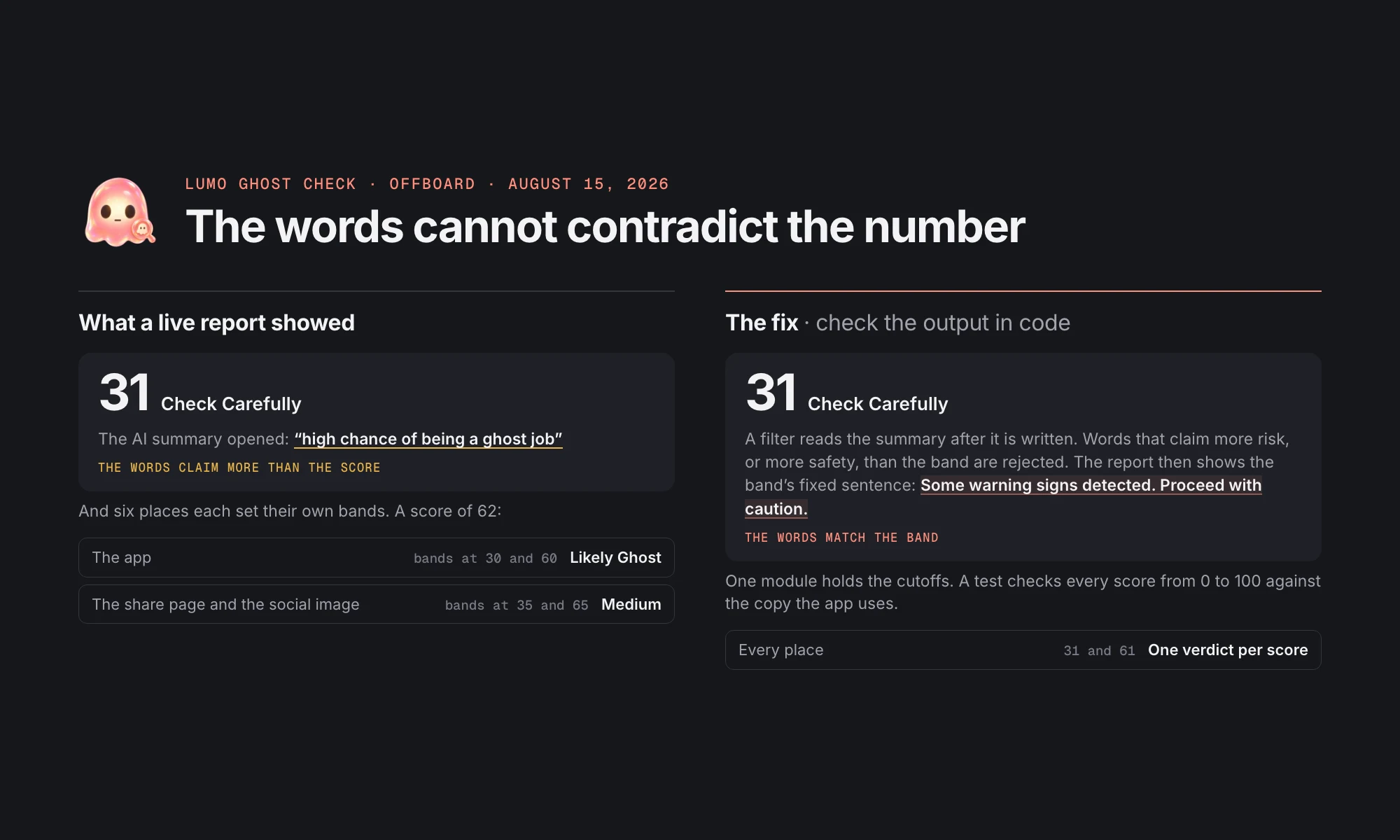
On August 15, 2026 a live report showed a score of 31, the verdict "Check Carefully", and an AI summary that opened with "high chance of being a ghost job".
There were two causes. The summary prompt had nothing that tied it to the band. And six places in the product each defined the bands on their own: 30 and 60 in the app, 35 and 65 on the share page and the social image. The same score of 62 read "Likely Ghost" in one place and "Medium" in another.
- I kept the direction of the score. Turning it into a "legitimacy score" would flip the meaning of every stored score, cached report, sent email and shared link, and it would not fix the bug.
- One module holds the band cutoffs. A test checks every score from 0 to 100 against the copy the app uses.
- A filter reads the summary after it is written. If the words claim more risk, or more safety, than the band supports, the product shows a fixed sentence for that band.
The lesson I wrote down: telling a model the verdict in the prompt does not ground it. Check the output in code.
The filter was tested on 24 written summaries with no wrong rejection. How often it fires on real summaries was never measured; I closed that as not worth the work at the current volume.
The public checker asks for nothing before it runs: no login and no email. One link field, then the full report on the page.
The first recommendation was to ask for an email before the check. I rejected it. A gate puts friction in front of a visitor who has no reason yet to trust the tool.
- Repeat links cost once. The public checker runs as one system account, so the 7-day result cache is shared by every visitor: a link someone already checked comes back at once.
- A shared report is a page of its own. It invites the next visitor to run a check. The shared copy leaves out the link the person pasted.
- What the review showed. The email ask after the result had missed its target, and I retired it as the page's goal. The page's job is traffic and trust, not the list.
Value first, asks after
- Paste a job link
- Checked in the last 7 days?
If YesThe saved report, at once
- The engine runs
- The full report on the page
- Then the asks: share, or watch this job
The score has three bands: 0 to 30 "Looks Legit", 31 to 60 "Check Carefully", 61 and above "Likely Ghost".
- The check runs first. In a packet, the ghost check runs before the resume and the cover letter. At 70 or above the build stops there, before the tailored resume and the letter are written.
- Below the line, the person decides. From 61 to 69 the result is a warning and the person may go on. The check is a warning, not proof that a listing is fake.
Where a packet build stops
- A packet build starts
- Ghost check runs first
- Score 70 or more?
If YesThe build stops here
- Score 61 to 69?
If YesA warning; the person may go on
- Resume and cover letter
A score is a reading on one day. A posting can close a week later.
- Watch this job. A visitor can ask for an email when a posting changes. One monitor runs per job link, however many people watch it. In the live test, a judged change sent one email, a retry of the same webhook sent none, and unsubscribing removed the watcher and the monitor.
- A closed posting shows on the tracker. Since September 25, 2026, a tracked application shows "Posting closed as of" a date when its job posting goes away. A daily job checks saved links with a free probe, at no scraping cost.
The ghost check is live in the six places above. Usage numbers stay private. The numbers below are test and system results.
- Cost per check. On August 26, 2026 new cost logging showed that a public check billed about 10 to 17 scraping credits, not the 1 to 2 I had assumed. Two causes: the scraper's own AI extraction duplicated a step the pipeline already ran, and a browser agent fired on 13 of 20 public runs. The fix shipped the next day. The reviewer found a defect the plan had missed and sent the work back twice before it merged.
- A model swap, checked first. In October 2026 I checked a newer small model on the ghost pipeline before switching: 3 live postings, 5 stages, each recorded once and replayed twice. It passed only after a one-sentence prompt fix, for the stage that reads employer reviews. With the fix, 18 of 18 flags were false on real requests, and 18 of 18 were true on the same requests with a dated layoff and three recent ghosting reviews added. A first wording dropped 2 of 3 true signals and was rejected.
- Tests. The engine has 104 tests in 12 files.
- Real traffic found a gap. LinkedIn job links failed when the checker first met real traffic from LinkedIn, because the scraping service cannot render that site. It was fixed the same week.
The result page looks much the same as it did before these decisions. They changed whether the number deserves to be believed: what counts as evidence, whether a check ran, whether the words agree with the score, and where the product stops.
One item is still owed. The band cutoffs were due a re-measure from production data about two weeks after the revived signals shipped, and that has not been done.