
Neuron Shift / Experiment
Preserving operator judgment across shift changes
- Operator workflows
- Design engineering
Neuron Shift: an independent prototype exploring asset context, reversible decisions, and a handoff that preserves the reason behind an action. Simulated data; no live model or operator research.
Independent exploratory prototype, developed for my interview preparation. Not affiliated with or endorsed by Teserac. All operational data is simulated. No live model, telemetry, or operator interviews.
Try the simulated demo(opens in a new tab) · Original case study(opens in a new tab) · Source code(opens in a new tab)
Premise
An incoming operator needs more than what changed. They need to know what someone decided, why, and what would make that decision worth revisiting. I used shift handoff to explore that interaction problem.
The user model is a hypothesis based on public material. It has not been validated through operator research.
Walk through one inherited decision
- Open the shift brief and inspect the UPS-A1 handoff item.
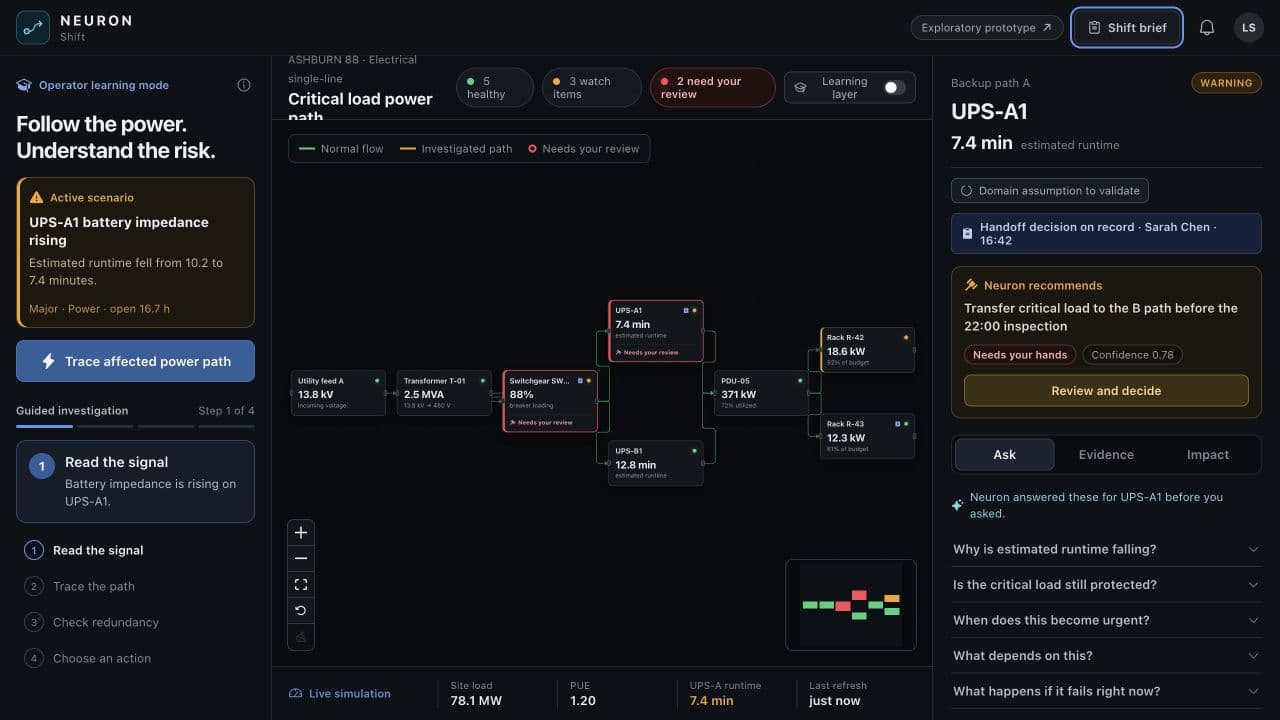
- Start the shift and trace the affected power path. Compare the asset evidence with its downstream impact.
- Review the recommendation. Approve, defer with a revisit trigger, approve with changes, or reject with a reason.
- Inspect the decision record and the reasoning the next shift would inherit.
Interaction decisions
Attach intelligence to the asset. Keep the recommendation, supporting evidence, and impact in the context of the equipment being investigated. The operator should not have to reconstruct that connection from an isolated chat thread.
Scale friction to reversibility. A low-consequence inspection and a consequential operational change should not ask for the same commitment. The prototype explores decision gates, not a validated operational safety policy.
Preserve reasons for deferring and overriding. A defer decision can contain useful judgment. Save the reason and revisit condition so the next operator can distinguish intentional waiting from neglect.
The inherited decision record
- Asset and situation
- Recommendation
- Human decision
- Reasoning
- Revisit condition
- Author and time
Building the prototype
The prototype computes reachability through its modeled graph so the impact view can follow the selected asset. It is a simplified electrical topology, not an engineering simulation; for example, it does not model generators.
Decisions persist locally in the browser. There is no backend, authentication, live telemetry, or model call. The implementation exercise is about consistency between the graph, the recommendation, and the inherited record, rather than proving the recommendation is operationally correct.
Limits
The largest untested assumption is that this record contains the context an incoming operator actually needs. I would ask an operator to interpret a handoff, investigate one item, and author the outgoing record, then examine what they omit, distrust, or look for elsewhere.
A working interaction demonstrates the idea. It does not establish usefulness, safety, adoption, or compatibility with a real facility.